

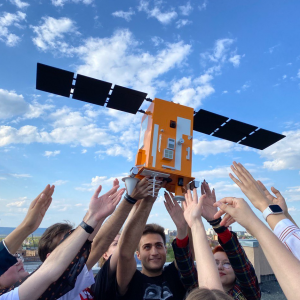
Samara National Research University is launching a new portfolio of short-term educational programs focused on the development of space systems. These programs are designed for students, faculty, and academic staff from higher education institutions across Russia.
Implemented under the federal project "Personnel for Space" (Kadry dlya Kosmosa), these programs reflect the core DNA of Samara University:
- Spacecraft Attitude and Orbit Control for Deep Space Missions
- Modern Technologies for Developing Small Earth Observation Spacecraft
- Mathematical Modeling and Applied Engineering of Space Systems
The "Spacecraft Attitude and Orbit Control for Deep Space Missions" program is designed to equip participants with practical competencies in:
- Designing and providing ballistic support for deep space missions;
- Managing spacecraft orientation using artificial intelligence methods;
- Digital data processing and machine learning technologies.
Project Lead: Olga Starinova, Professor and Head of the Department of Flight Dynamics and Control Systems at Samara University.
The "Modern Technologies for Developing Small Earth Observation Spacecraft" program focuses on building robust competencies and practical experience in:
- Designing, simulating, constructing, and assembling spacecraft;
- Testing small Earth observation spacecraft using advanced technical training tools.
Project Lead: Sergey Safronov, Head of the Department of Spacecraft Engineering named after Chief Designer D. I. Kozlov.
The "Mathematical Modeling and Applied Engineering of Space Systems" program is aimed at mastering the end-to-end engineering cycle for developing small spacecraft components. Participants will:
- Develop control system models in SimInTech and conduct virtual testing;
- Assemble small spacecraft construction kits in the university laboratory.
Project Lead: Alexander Ledkov, Associate Professor at the Department of Theoretical Mechanics, Samara University.
"Samara University possesses unique experience in the development, creation, and operation of small spacecraft for various purposes. For decades, the university's leading scientists have been implementing educational and scientific-technical projects in aerospace technologies. As a core university for the Roscosmos State Corporation and a base university for the engine-building enterprises of the Rostec State Corporation, the university, together with the Progress Rocket Space Centre, has developed and launched a series of 'AIST' small spacecraft. We are also preparing for the launch of the 'SamSat-Orion' nano-satellite for Earth's ionosphere research, which will join the currently operating 'SamSat-Ionosphere' and nanosatellites equipped with hyperspectral instruments in orbit. Participants in the new educational programs have the opportunity to be trained by specialists who study outer space and create technologies for its exploration on a daily basis, thereby acquiring new, unique competencies highly demanded by leading industry enterprises," emphasized Olga Esipova, Head of the Career and Employment Department at Samara University.
Program Details
- Duration: September 15 – December 15, 2026.
- Format: Online / Offline at Samara University.
- Tuition: Free of charge. Places are limited; registration is required at https://edu.ssau.ru/.
- Eligibility: Students, faculty, and academic staff from any higher education institution in Russia.
- Certification: Upon successful completion, participants will receive a Certificate of Advanced Training.
For Reference:
The Russian Ministry of Science and Higher Education's federal project "Personnel for Space" is implemented within the framework of the national "Space" project. It aims to create a holistic system for training highly qualified specialists for the rocket and space industry.
The strategic goal of the project is to provide the Russian space industry with competent specialists capable of solving national-scale tasks—from fundamental research to the creation of advanced space systems and complexes, in accordance with the Concept of Technological Development up to 2030.
